


Odour strength
Medium
Listed qualitative strength

Price range: £8.99 through £323.99
Odour description (decreasing) Camphoraceous, Pine, Fresh, Woody, Slightly Minty
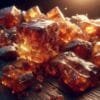
L-Borneol gives an aromatic composition a clear, camphoraceous edge, combining pine-like freshness with a dry woody undertone and a lightly minty impression. Its character suggests cool air passing through coniferous woods: crisp, distinctive and immediately recognisable.
A monoterpenoid alcohol, L-Borneol is the levorotatory form of borneol. In perfumery, its value lies in the contrast it can bring to softer notes, sharpening an herbal theme or introducing a cooler outline around citrus and woods.
Explore it as an accent in aromatic and coniferous studies, or compare its effect in a simple lavender and bergamot framework. Its woody side can also provide a useful link towards cedarwood materials as the fresher notes settle.
Work in small, weighed trials and increase gradually. A restrained amount can lend clarity and lift; when the camphoraceous facet becomes prominent, it changes the direction of the whole accord.
Highlights from the material’s listed odour profile.
Top note · Heart note
Listed qualitative strength
16 hour(s)
at 100%
Listed reference conditions
Top note · Heart note
Illustrative note development · no measured evaporation data

C10H18O
Computed and structural reference properties for the named compound. These are not measured supplier specifications or properties of a complete dilution, mixture or batch.
Reference data checked 2026-10-27.
This molecular reference matches the catalogue’s recorded CAS and formula. It does not confirm the supplied grade, purity, stereochemistry, isomer proportions, composition, impurities or unlisted constituents.
Generic regulatory reference only. This is not a supplier allergen declaration, measured composition, allergen-free claim or finished-product labelling assessment.
Raw-material reference based on recorded CAS numbers. A CAS match identifies a reference entry; it does not verify the supplied grade, composition, purity or finished-product compliance. Naturals, bases and mixtures require composition review.
No direct listed-entry CAS match in this jurisdiction’s held reference set. This does not mean the material is allergen-free. Constituents, grouped entries and natural-material composition may require further review.
Finished-cosmetic declaration thresholds: greater than 0.001% leave-on; greater than 0.01% rinse-off. Apply the current target-market rules to the actual complete formulation; no concentration is inferred here.
Commission Regulation (EU) 2023/1545 · Regulation (EU) 2023/1545 with 11 November 2025 corrigendum; checked 2026-10-26.
Held EU transition dates: placing noncompliant products on the market until 2026-07-31; making them available until 2028-07-31. Check applicability and current law for the intended market. 2025 corrigendum.
No direct listed-entry CAS match in this jurisdiction’s held reference set. This does not mean the material is allergen-free. Constituents, grouped entries and natural-material composition may require further review.
Finished-cosmetic declaration thresholds: greater than 0.001% leave-on; greater than 0.01% rinse-off. Apply the current target-market rules to the actual complete formulation; no concentration is inferred here.
Regulation (EC) No 1223/2009, Annex III (Great Britain) · legislation.gov.uk current text checked 2026-10-26.
Current supplier composition or allergen declarations are required to assess naturals, bases, mixtures and actual concentrations. Reference data checked 2026-10-26; bundle 2026-10-27. Supplementary private documents remain separate.
| CAS number | 464-45-9 |
|---|---|
| Odour description (decreasing) | Camphoraceous, Pine, Fresh, Woody, Slightly Minty |
| Odour strength | Medium |
| Perfumery use | Effective from the smallest traces up to 10%Listed perfumery guidance; this is not an IFRA limit. |
| Substantivity | 16 hour(s) at 100% |
| Solvent | None |
| Physical state | Solid |
| Synonyms | Borneo Camphor, Bornyl Alcohol, 2-Bornanol, Bingpian |
| Recorded name / preparation | (1S-endo)-1,7,7-trimethylbicyclo[2.2.1]heptan-2-ol |
| Molecular formula | C₁₀H₁₈O |
| Supplier IFRA information | Catalogue copy mentions IFRA information, but no reviewed supplier-document record is available in this profile. No certificate, use limit or compliance status is confirmed. |


Signal word: Warning
Hazard statements:
Precautionary statements:
Professional/Industrial use only.
Available documents are attached to eligible completed orders in your account.
Sign in to view your ordersMy account → Orders
Supplementary documents are supplied only where explicitly listed and available. Check documentation information
Purchased as a guest? Follow the SDS request guidance in our Documentation Supply Policy and provide proof of purchase.
Documentation Supply PolicyGeneric reference only — not an IFRA certificate, compliance decision or use recommendation. The Responsible Person and qualified safety assessor must assess the actual finished formula using current applicable IFRA Standards, supplementary documentation where available and the CPSR.
Raw-material reference based on recorded CAS numbers. A CAS match identifies a reference entry; it does not verify the supplied grade, composition, purity or finished-product compliance. Naturals, bases and mixtures require composition review.
Source: 51st Amendment overview, held source checked 2026-10-21. Bundle 2026-10-27. Individual Standards prevail over the overview.
No direct IFRA overview entry matched the recorded CAS in this held dataset. This does not mean unrestricted use, absence of relevant Standards or compliance. Constituent restrictions may still apply.
IFRA source overview · Individual IFRA Standards and supplementary documentation
Supplier certificates and private documents are separate evidence. Their availability does not determine whether this generic guide is shown. This is a dated local reference, not a live regulatory feed.
Explore a citrus-and-herb opening that keeps the herbal character distinct. Compare a brighter peel variation with a gentler citrus reference, noting whether the imagined result feels like a garden cologne or a more culinary aromatic study.
Place the herbal material beside a familiar flower, using the flower alone as your reference. Compare the green and floral impressions through the evaluation and decide whether the herb should read clearly or remain an accent.
Build a simple herbal wood sketch and compare a dry wood option with a smoother one. Keep the aromatic material constant so the study reveals which setting gives your idea the clearest shape and most useful contrast.
| Volume | 10g, 30g, 100g, 250g, 500g, 1kg |
|---|
Concept illustration only; no dilution ratio or carrier is implied for this material. Refer to the product specification and label.
A D at the end of a product name usually indicates a dilution. There are exceptions, so check the listing to confirm how the material is supplied.
POD means Precious Oil Dilution, typically intended for aromatherapy applications. AOD means Absolute Oil Dilution, a diluted absolute.
Before ordering, check the product specification for the concentration and carrier or solvent. These details also appear on the product label. If a title or abbreviation differs from the specification, the product specification takes precedence.
Some product names include letters in brackets that we use as internal catalogue references. These may refer to a fragrance house named in the product description. Examples include (F) for Firmenich, (I) for IFF and (G) for Givaudan.
For details of the material’s grade, supplied strength or carrier, please refer to the product specification.
For professional perfumery use only. Not for direct application to skin or ingestion. Keep out of reach of children.
Handle using the precautions specified for the material. Wear suitable protective gloves and eye protection where required.
Keep away from sources of ignition where applicable and avoid release to the environment.
Keep containers securely closed and store under the conditions specified on the product label and SDS. Keep liquid containers upright.
If swallowed or otherwise exposed, follow the SDS first-aid instructions and seek medical advice as appropriate. Do not induce vomiting unless directed by a medical professional.
Product-specific warnings, handling precautions and storage requirements take precedence over this general information.
A Safety Data Sheet (SDS) is available to logged in users who have purchased this item, where applicable.
Once an order is marked Completed, sign in and go to My Account → Orders. Open the relevant order to download the Safety Data Sheet (SDS) for the material, where applicable.
Read the applicable SDS before handling or using the material. Follow its instructions for hazards, protective equipment, first aid, handling, storage and disposal.
An SDS provides information about the material supplied; it does not replace an assessment of the safety or compliance of a finished formulation.
Please note that supplementary documentation—including, but not limited to, IFRA Certificates, Certificates of Analysis (CoA), Allergen Declarations, and other regulatory or compositional data—may not be available for all products. Refer to the "Supplementary Documentation" tab to check current availability. If the tab is not present, no supplementary documents are available for the material.
Customers intending to use materials in cosmetic applications, including for the preparation of a Cosmetic Product Safety Report (CPSR) under UK and EU Cosmetics Regulations, must contact us prior to purchase to confirm the availability and suitability of any required documentation where it is not explicitly stated. Orders must not be placed in reliance on the assumption that such documentation will be provided where it is not explicitly stated on the relevant product page at the time of purchase.
By proceeding with a purchase without prior written confirmation, you acknowledge and accept that documentation beyond the legally required SDS may not be supplied, and you agree that Perfume Extract shall not be held liable for the absence of such documentation or for any inability to complete regulatory requirements, including CPSR or product compliance obligations.
Products are supplied in accordance with our Documentation Supply Policy
The following additional documentation is available as a download to logged in users who have purchased this item:
The supplementary documents currently available for this material are identified in this tab. Availability varies between materials.
Batch-specific certificates, analytical results and additional technical data are not guaranteed. They are supplied only where their availability is expressly confirmed in this tab or separately confirmed by us in writing.
Where provided, supplier IFRA documentation does not replace a comprehensive safety assessment or constitute approval of a finished formulation. Customers must consider their complete formulation and intended application.
Any linked IFRA standard is provided for reference and is not a batch-specific specification or analytical certificate for the material supplied.
Do not assume that documentation confirms a particular batch, residual constituent level, manufacturing process or analytical result unless it expressly states this.
The same limitations apply to allergen declarations, Certificates of Analysis (CoAs), technical data sheets, specifications, and other regulatory, analytical or compositional documents. These documents provide information only within their stated scope; they do not replace a comprehensive safety assessment or constitute approval of a finished formulation, nor do they guarantee suitability for a particular application. Customers must assess their complete formulation and intended use.
These limitations apply to reliance on all documentation supplied, including IFRA information, allergen declarations, Certificates of Analysis (CoAs), technical data sheets, specifications and other supporting documents.
Perfume Extract is solely a reseller of this product and is not an agent, official distributor, or affiliated in any way with the manufacturer.
Customers are responsible for determining whether the material and available documentation meet their requirements before purchase, and for assessing the safety and compliance of their finished products.
We do not provide formulation instructions, formulation consultancy or confirmation of suitability at a particular concentration or for a particular application.
Producer identity, detailed sourcing and processing information are not disclosed beyond the information published in the product listing.
Please read our Documentation Supply Policy alongside the product specification and available documentation.
Synonyms, alternative names, CAS/EC references, botanical names, manufacturer references and external links may describe a substance or material family generally. They should not, on their own, be taken as confirmation of the supplied material’s producer, geographical origin, manufacturing process, grade, purity, constituent levels or batch characteristics.
In particular, a synonym or reference must not be used to infer that a material is free from a particular constituent, meets a numerical specification, or is suitable for a particular application or concentration.
IFRA information, allergen declarations, Certificates of Analysis (CoAs), technical data sheets and other supporting documents apply only within their expressly stated scope. A general specification or reference document is not a batch-specific analytical result unless it expressly identifies the relevant batch.
If information appears inconsistent, or a particular characteristic is essential to your purchase, contact us for written clarification before ordering. Do not resolve discrepancies by assuming that a synonym, external reference or document for another grade applies to the material supplied.
We do not confirm characteristics beyond those expressly supported by the applicable product specification or our written confirmation. Customers remain responsible for assessing their complete formulation and intended application.
Nothing in this information excludes or restricts liability or statutory rights that cannot lawfully be excluded or restricted.
Odour description (decreasing): Creamy, Dairy, Milky, Earthy, Ketonic, Waxy, Lactonic, Vanilla, Cheesy

Odour description (decreasing): Floral Cyclamen, Fresh, Linden Blossom, Green, Rhubarb
Odour description (decreasing): Rancid Butter, Sour

Odour description (decreasing): Fruity Pineapple, Banana, Juicy Fruit, Tutti Frutti, Cognac, Powerful

Odour description (decreasing): Amber, Ambergris, Woody, Dry, Clean, Diffusive & Fixative
Odour description (decreasing): Fruity, Pineapple, Cocoa, Peach, Mango, Amber.

Odour description (decreasing): Sweet, Vanilla, Vanillin, Powdery, Chocolate, Powerful.

Odour description (decreasing): Sweet, Spicy Clove, Woody, Dry with Phenolic, Cinnamon and Allspice Nuances.

Odour description (decreasing): Amber, Ambergris, Woody, Dry, Clean, Diffusive & Fixative

Odour description (decreasing): Velvety, Silky, Woody, Dry, Ambergris, Lemon, Floral. Diffusive & Fixative

Odour description (decreasing): Mild, Solvent, Balsamic

Odour description (decreasing): Sweet, Vanilla, Vanillin, Powdery, Chocolate, Powerful.
Quantitative IFRA limits relate to the relevant use category and concentration in the finished consumer product. Include restricted ingredients contributed by every material in the formula. IFRA conformity does not replace a safety assessment.


Reviews
There are no reviews yet